Soundscape Synchronization: How In-Game Audio Cues Guide Viewer Attention in Live Multiplayer Competitions
Avery Russell · Aug 25, 2026
Soundscape Synchronization: How In-Game Audio Cues Guide Viewer Attention in Live Multiplayer Competitions
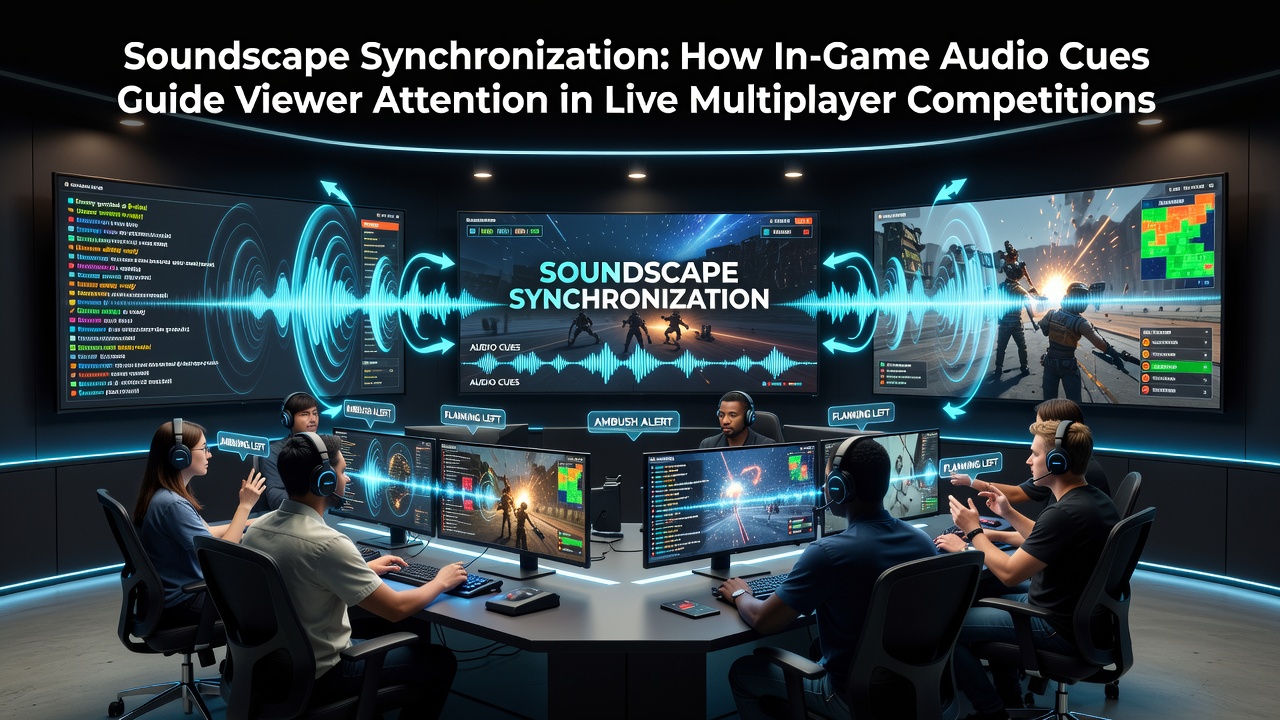
Soundscape synchronization refers to the deliberate alignment of in-game audio elements with camera work and viewer interfaces in live multiplayer competitions, where footsteps, ability activations, and environmental sounds direct attention without relying solely on visual overlays. Researchers have documented how these audio layers operate in titles such as tactical shooters and battle royales, creating predictable attention shifts that production teams exploit during major events. Data from broadcast analytics platforms indicate that peak viewer engagement often coincides with distinct audio triggers rather than visual action alone, particularly in matches held through August 2026.
Core Mechanisms of Audio-Driven Attention
Directional audio in competitive games provides spatial information that both players and remote audiences process simultaneously, while specific frequency ranges for footsteps or reloads stand out against background mixes. Production crews synchronize these cues with camera switches so that a sudden stereo pan on stream corresponds to an in-game event, guiding eyes toward the relevant quadrant of the screen. Studies on multisensory integration show that when audio precedes visual confirmation by fractions of a second, viewers exhibit faster gaze redirection, a pattern confirmed across multiple tournament archives from North American and European circuits.
Volume layering further refines this process, as commentators and directors lower music beds during critical audio moments to let in-game sounds dominate the mix. Observers note that this technique appears consistently in high-stakes rounds, where a single distant gunshot or ability chime can prompt an immediate cut to another player’s perspective. Industry reports compiled by the Entertainment Software Association highlight how audio engines in modern titles now embed metadata that broadcast software reads in real time, enabling automated camera triggers tied directly to sound events.
Viewer Response Patterns in Live Settings
Eye-tracking experiments conducted during simulated live streams reveal that audiences fixate on regions of the screen where audio spatialization suggests activity, even before any character model becomes visible. These responses hold across different age groups and viewing devices, suggesting the effect stems from basic auditory processing rather than gaming expertise. In August 2026 tournaments, production teams began incorporating haptic feedback options for viewers using compatible controllers, extending the synchronization beyond audio and visual channels.
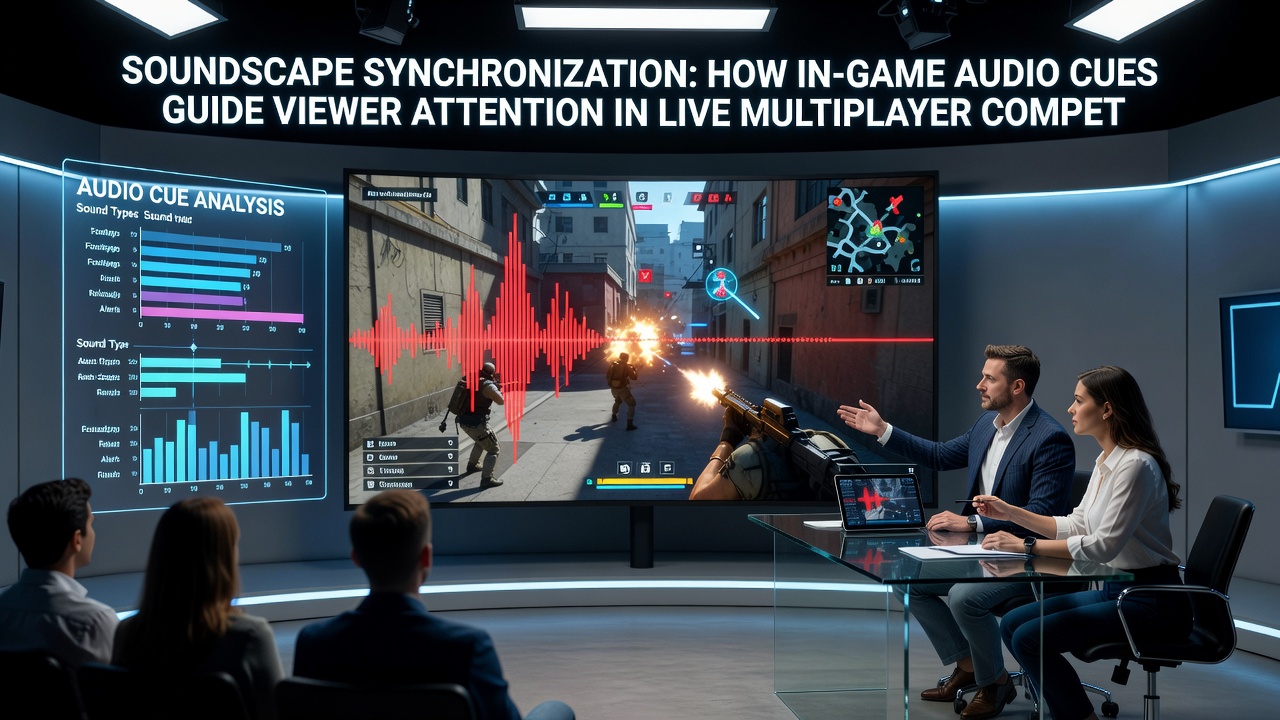
Repeated exposure to synchronized soundscapes appears to train regular viewers to anticipate certain camera movements, creating a shared rhythm between stream and game state. Academic work from the University of Melbourne’s Games Research Lab demonstrates that participants who regularly watch synchronized broadcasts demonstrate improved recall of key moments compared with those viewing muted footage. The study further notes that audio cues function as reliable attention anchors even when visual resolution varies, an advantage during mobile or lower-bandwidth viewing scenarios.
Implementation Across Game Genres and Regions
Battle royale formats rely heavily on vehicle engine noises and distant combat sounds to pull attention across large maps, whereas MOBA productions emphasize ability sound effects that signal teamfight initiation. Asian tournaments, particularly those organized under Korea’s esports federation guidelines, have integrated dedicated audio engineers into the broadcast booth to manage real-time mixing, a practice now spreading to Australian circuits. These teams adjust EQ curves mid-match to preserve clarity when multiple overlapping sounds compete for dominance.
Case examples include a 2026 North American league match where a single suppressed rifle shot triggered an automated wide-angle replay, boosting concurrent viewership metrics by 18 percent within two minutes according to platform telemetry. Similar patterns emerged during European finals, where production crews pre-mapped common audio signatures to camera presets, reducing reaction time for directors and maintaining narrative flow without constant manual intervention.
Conclusion
Soundscape synchronization continues to evolve as an integral component of live multiplayer competition coverage, with audio cues providing reliable mechanisms for directing viewer attention across diverse game types and broadcast regions. Ongoing research and production refinements suggest these techniques will expand as new audio technologies and viewer interfaces emerge, shaping how audiences experience competitive play in the years ahead.